skip to main |
skip to sidebar
I am delighted when people wear plants, and I am delighted when I get to turn a calendar page. Thus today is particularly fine, seeing as how it is May Day and a good excuse to put on a wreath of flowers.
I made one from felt for my granddaughter, Heidi, and although I am not sure she will be wearing it today, I like to think she will -- somewhere in New Jersey, perhaps in a garden, with sun on her shoulders.
In my experience, making a book is a slow and oddly tense undertaking. For my current project based on the first chapter of Margaret Fuller's Summer on the Lakes in 1843, the initial challenge was accurately transcribing the original text, including checking on antique spellings such as visiters and choak. Because I am not using imposition software to organize the folios of words and image, I have to depend upon myself to make sure everything is in the right order and right-side-up. As any proofreader knows, this is a challenge when you are really, really familiar with the text.
When the twenty-two folios of this book, five folded pages each, were assembled, I was ready to sew them together. You might imagine this to be peaceful, meditative process, but hanging on to the ever-tall stack of pages while wielding the needle and waxed thread, not tying myself in knots, is no easy task.
Gluing up the sewn book block brings stability and a growing sense of bookiness to the whole thing. As of this morning, the body is secure, the end bands tight and straight, and Ms. Fuller's heady description of Niagara Falls is ready for a spine.
For a few years I have been circling gingerly around a book project suggested by Priscilla Juvelis, the astute owner of Priscilla Juvelis Rare Books in Kennebunkport. She thought that the writings of Margaret Fuller -- author, editor, journalist, literary critic, educator, Transcendentalist, and women’s rights advocate -- would resonate with me and with the themes I bring to my book object work. Priscilla was right, and I am intrigued by this Margaret Fuller -- trail-blazing, intellectual, and highly, deeply sensitive.
Her book Summer on the Lakes in 1843 is packed with observations about the journey she made from the cultured atmosphere of Cambridge and Concord to the wilds of Buffalo, Chicago, and Milwaukee. It is, however, her nearly fevered experience of Niagara Falls that asked to be transcribed, translated, and re-imagined in my studio.
I have had my own love affair with Niagara Falls, and Margaret Fuller's response is entirely understandable to me. The phenomenon of the place nearly undoes her sensibilities:
"My nerves, too much braced up by such an atmosphere, do not well bear the continual stress of sight and sound. For here there is no escape from the weight of a perpetual creation; all other forms and motions come and go, the tide rises and recedes, the wind, at its mightiest,moves in gales and gusts, but here is really an incessant, an indefatigable motion. Awake or asleep, there is no escape, still this rushing round you and through you. It is in this way I have most felt the grandeur---somewhat eternal, if not infinite."
So now I have gathered my own easily excited nerves and have embarked on a book of only one chapter -- Niagara, June 10, 1843. Her words are illustrated and, I hope, illuminated by my digital composites of rocks and water. The book will be dense with paper, thread, transparency, and rhythm. The structure that will house it is still in my mind --- sparkling, fluid, heavy, blue, and vivid.
My studio days are full of interest as I help a friend with a mounting and framing project. She is the custodian of memorabilia belonging to one of the American soldiers who was on Okinawa in 1946. The collection of personal objects, military medals, and photographs fairly hums with voices from the past.
I lived on Okinawa in the late 1960's when the Ryukyu Islands were still under United States military command, and it is compelling to see the same regalia on the dancers, the same landscape, and the same tomb entrances we sought out, interested in the island's culture, decades after the battle for Okinawa.
How different the perspective of this young G.I. who notes on the back of one photograph that these are the people he was fighting against only weeks before. In the collection is a Japanese flag, the Rising Sun hand-stitched on a tan field that is, most curiously, painted with an image of Mount Fuji, a torii, and the words "Okinawa." What can be the story of this remarkable piece of cloth?
Handling these objects and helping to preserve them is a moving experience, resonating with vivid history and private lives. It is just the kind of thing that makes a studio life so rich.
When I am not in the studio, I work for a really big retail store. One of my jobs is putting stuff on the shelves. The other is picking up after people when they decide that they really don't want to purchase something. This second assignment is tremendously interesting. For example: here I am, going along, efficiently plumping up spa towels, when all of a sudden I find an Angry Birds sippy cup, tucked discretely behind a stack of Muddy Azure Luxury Bath Sheets. And look over there, behind the Down-Alternative Pillows! A manly-sized bag of beef jerky.
Because there is no designated dumping bin in the store to stash the things you realize you don't need, can't afford, or never should have picked up in the first place, you have to do something with your tube of Peppermint-flavored Pringles Potato Chips. I understand. You could trek back to the Healthy Snack Section, or you could make better use of your time and put it somewhere where it would eventually be found and returned to its proper home.
I am endlessly intrigued by this unchoosing process. As shoppers, we have a sense that there must be cameras or people watching us and that unloading the item that has lost its allure will probably be observed. Right? Wrong. I have yet to see the stashing of an orphan product, When I find one, I do like to think about the shopper's strategy:
1) Putting this thing here is not really not too far from where I got it.
2) It's kind of the same shape and sort of the same color as the stuff already here.
3) Someone in the diaper aisle may just happen to need romantic pillar candles.
4) I really have to get out of this store. Sorry.
It's okay. Really. When you have to discard a sweater in the pickle section, don't feel bad. You have entertained me.
I am lucky to have Louise. She has been my friend since we met in sixth grade and discovered that there could be -- if the stars are right -- someone else who is just like you. Sure, I know that it is wonderful and challenging to encounter and to love people who are total mysteries to your mind and heart, but you can't beat having a friend like Louise
She is not a simple person, although her way of living is careful and orderly. She is utterly brilliant, but her way of being in the world is respectful, inquisitive, and admiring. Louise has a potter's gesture that reveals itself when she is making tea or making up the guest room. She knows just about all there is to know about Asian ceramics but is always on the prowl for new ideas and other ways of looking at things.
For her birthday, for the new year, and to mark our long and important friendship, Louise sent me a beautiful Vietnamese robe. She and I will wear these dragons on our spines, together, simultaneously, and forever.
It is interesting to me that these days the main actors in Christmas traditions are human or at least as human-like as angels and elves can be. Perhaps this anthromorphing has something to with the Age of Reason, the Industrial Age, or man's supposed mastery over the planet. Who knows? In contrast, old Scandinavian traditions designated a goat as the driving force of Christmas. This animal, the Julebukk, was the mythic descendent of Thor's companion. In rowdy Viking ceremonies, the divine and fearsome goat was portrayed by a man who would customarily die and be born again.
The early Nordic Christians raised the stakes and viewed the goat as a sort of welcome devil who would appear in times of wild celebration. The Church was not pleased, thank you very much, and forbade the Christmas Goat which, when not acting out, had turned to supervising Christmas preparations and giving gifts. Eventually the active role of the Julebukk faded, to be replaced by the Julenissen, the Christmas Troll.
You had to watch out for the Julenissen as well. If you did not provide it with a Christmas Eve bowl of rømmegrøt, a porridge made of sour cream, whole milk, wheat flour, butter and salt, it would retaliate by killing all your cattle. Norwegians take things very seriously.
When I spent a Christmas in Norway, we set a straw Julebukk next to the chimney to guard the rømmegrøt, and -- sure enough -- everything turned out fine. So tonight, as Christmas Evening comes to us, I wish you friendly visitations and much joy.
I love this evening. In Scandinavian traditions, December 23rd is Lille Julaften -- Little Christmas Eve. Taking note of this night spreads the pleasure of Christmas forward and intensifies anticipation. When I lived in Norway as a teenager, preparations for Christmas did not really begin until Lille Julaften. That was the day when people shopped for gifts and put up a tree which was decorated solely and purely with white lights, Norwegian flags, and small balls of white cotton snow.
Lille Julaften became part of my life as a young mother, wife, and artist in Cleveland as we threw a big party that drew together people from all parts of our lives -- neighbors, friends, family, work colleagues, and eventually friends of friends and friends of family. The preparations were daunting -- huge quantities of eggnog and strong punch, buckets of 1/2 inch round Swedish meatballs. I accomplished Herculean feats of lefse-making and fragile cookie cakes. And it was all wonderful as everyone I loved gathered together.
So tonight, even if you are far too busy and your list of tasks is still too long, even if the Christmas music that has played in your ears since Halloween has grown tedious, even if you are sad, even if you miss someone, perhaps there will be a moment of quiet joy and sweet anticipation of better times as Lille Julaften works its small magic.
I have used this loyal hip for a long time -- learning to walk, chasing my sister, climbing, dancing, running, skating, skiing, accelerating, and generally having a fine time. It is now time to give it a rest and get a substitute joint. How about something that looks like it was machined at Bayerische Motoren Werke AG, as sleek and expensive as a new car?
So off I will go on Pearl Harbor Day to have my hip replaced, interested in the whole process, eager to move again without discomfort & this annoying limp, and grateful.
When I last stopped by Shady Maple Farms for fresh, right-out-of-the-hen eggs, Ms. Linda asked if I cared for a blue egg. Who could resist that offer? The egg is the offspring of a Blue Hen, who was abandoned injured at the county fair by some really bad actor of a 4-H kid. Ms. Linda and her husband, the vet, named the chicken Lucky, for good reason, and took her back to Shady Maple for recuperation and poultry companionship.
The egg is not a brilliant, knock-your-socks-off blue but rather a sweet, light azure, and we are delaying cracking open such a lovely thing. When we do, it will be our lucky day.
When my ten-year-old granddaughter, Sterling Knight, visited for a week, we spent much of our time in my studio. She arrived with Fluffy, a cunning, lavender-plush, weasel-like toy pet who needed a house. As it turned out, Fluffy actually needed a contemporary, four-story condominium with a private elevator and garage for the red convertible Sterling would make for her/him.
Beyond the satisfaction of using odds & ends, materials, and saved objects for which I could not imagine any use but had kept anyway, the real delight was watching Sterling work. She is deft and understands how to put things together. She sees possibilities and has an intuitive sense of structure and proportion. What I really admired, however, was the way she did not self-edit. There was no "This looks all yukky and stupid." If a chair made of boxes, scrap leather, cotton balls, and brads was a little wonky, she accepted it and moved on to construct a big-screen television. The home was packed with imagination, clever ideas, originality, and fun.
Above all she worked with enthusiasm and self-confidence, making what she wanted to see, making what would give Fluffy pleasure. Any artist can learn a lesson from this young girl.
After my son, Ryan, died two months ago, I kept moving forward with work --- in disbelief, in sadness, but buoyed by the love that poured over me from all quarters of my life. It was possible to work slowly in the studio, and I was able to measure, cut, paste up, print, and generally accomplish things. There is a notion, translated roughly from the German, of "grief bacon," a slowness, a layering of emotion much like hibernation that comforts, nourishes, and protects those who have experienced loss. I had the grief bacon. Still do.
The action that brought me pleasure and peace was knitting, to no knitter's surprise, and I wanted to make something for Heidi, Ryan's young daughter. At Red Purl in downtown Niles, my choice was immediate, soft, and white: yarn that Amy had spun from local sheep.
Delicious between my fingers and heaven to my eyes, it invited another yarn to ride along -- something perfectly named Little Flowers. The bright bits strung along the fiber remind me of Tibetan prayer flags.
So I knit my heart and my healing, my love for Ryan and his life, for his children, for all children into this rhythm of white and pink and red and sparkle.
You don't have to be in Austin long before you realize that people here pride themselves on being different. "Keep Austin Weird" is a slogan plastered everywhere. To me, the city is more "original" than weird -- packed with independent stores & restaurants and bearing an attitude of insouciance & the off-beat. It is an altogether engaging place to be.
A question though: is it the Austin attitude or the Whole Foods attitude that produced these parking jobs? All within a twelve-car corner of the lot. Even the Smart Car failed Driver's Ed.
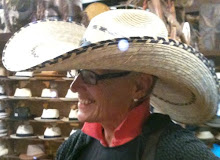
Ever since Al Shudde opened a hat store in Houston in 1907, four generations of Shudde men have been serving those who know the importance of a good hat. Several years ago in Houston, Edward (one of those who can wear any hat with style and conviction) spotted a man wearing an exceptional cowboy hat. After chasing him down, Edward learned that it came from Shudde Brothers Store and Hat Factory, and yesterday we made a pilgrimmage.
What a wonderful place -- hats, hat forms, hat steamers, and Neal Shudde who knows all there is to know about fitting, wearing, and maintaining hats of character. I nearly succumbed to a black wool derby, thinking that wearing it would unravel the unbearable lightness of being. I did receive a gift of sharp, narrow-brimmed, flat-topped, straw hat with attitude. I think that, wearing it, I will be unstoppable.
Edward looked fantastic in a black top hat, but he was on a quest for that exceptional hat.
It was amazing. It was undeniable. It was Edward.
I came across some small pieces of beautiful Asian papers and thought I would put together a diminutive book -- a few poems, a few images, bound simply and quickly finished. Beware such unambitious thoughts! Here I am, weeks later, in a complicated and enticing undertaking that has involved the purchase of more paper, the writing of more poems, the construction of more images, and some engineering possibly beyond my skill level.
The parts so far:
a chunky, poem/image-packed book with a beaded silk cover
a box that will hold the book and whose sides will have digital images printed on Yupo
the parts of a platform for the box
What is next in my imagination:
a statuesque cover for the platform that will have openings screened with knitted stainless steel yarn and a window in the top
a four-legged base for the whole business
Stay tuned.
I have taken up knitting again -- something I delayed for fifty years because I was afraid I would not remember how. Yes, I knitted when I was an exchange student in a small Norwegian town, but I did not actually learn to knit. Every girl and a few of the boys knitted all the time, everywhere, and so it was a no-brainer for me to hand any problem I created for myself over to the kid sitting next to me. To really knit again, to really create a textile, I would have to do some learning, and, because I prefer to do everything perfectly the first time, I put the project off.
Luckily for me on a visit to Cleveland, the seduction of the yarns at Liz Tekus' Fine Points http://www.finepoints.com/, proved to be no match for the habits of my ego, and I began to teach myself from books and on-line videos. The allure of holding and manipulating yarn is so compelling and delicious that I have been trying to figure out why I do it.
I know some knitters are in it for the creation of objects, and some perhaps for the challenge of patterns and structures. For me, it is the feel of silk or wool or cashmere or alpaca or merino between my fingers, in that sweet V between digits that is so sensitive and always available. As I child, I slipped my hair through that intersection for comfort and pleasure, and I have seen my mother and my grandchildren do it.
The act of knitting has many attractions --- gorgeous materials, visual construction, the emergence of pattern, the sound & action of needles, and the capacity to make something while talking and listening to others. Who knew it was also so sexy?
We live in Pokagon Township, a name whose pronunciation distinguishes locals from outsiders. You are probably thinking it is POE kah gone. Wrong. Poe KAY gun, for future reference. Be that as it may, after casting the 278th and 279th votes this afternoon, we drove home through our tiny village, Sumnerville. There is one church and one business in Sumnerville, and the latter has been in continuous existence since 1835, giving it historic status.
The Old Tavern Inn, once a stagecoach stop, has cultural status as a popular burger joint and a watering hole for people who drive pick-up trucks. Apparently there were cowboys chowing down today after exercising their right to vote, just up the road. We live in the past and the present, still knee deep in autumn leaves.
While city trees were ripping apart and crashing onto parked cars in Brooklyn and Queens last week, here in rural Michigan an old giant was being intentionally and methodically brought to earth across the road from our building.
Although a venerable sentry for the Sumnerville Bible Baptist Church, Old Tree was also a threat and a nuisance as it shed its branches in windstorms, and Dan the Minister had no alternative but to have it taken down--- heavy limb by heavy limb. We are relieved that all the neighborhood foresters survived the Felling Bee, and we are mesmerized by the sheer volume of wood, of accumulated vegetable growth -- photosythesis writ large -- that lies on the ground. The ancient girth of Old Tree stumped garden-variety tools, and someone will have to find a chain saw with a 36" blade if the remainder of the trunk is not to be a permanent lawn ornament in front of the church.

For all its dignity, the tree seems to have had an unfortunate name. Botanically, we are a casual lot around here, and we sort of agree that it is a Stinkwood tree. Green-a-Planet says that the Stinkwood is "tough and strong, and polishes well, but is difficult to work. It is a good general timber suitable for making planks, shelving, yokes, tent-bows and furniture. The African people have always used it to make a variety of household articles. It is also thought to have magical properties. The wood is mixed with crocodile fat as a charm against lightning, and many people believe that it has the power over evil and that pegs of wood driven into the ground will keep witches away."
Perhaps the mighty root system will continue to keep this little village free from harm.Taking the giant down required two hard days; reducing it to firewood will take weeks. We are grateful for its life, from shade to heat, with good juju.
After a hot and humid summer, the new season gave us a cool, bright, windy day, and with great pleasure I went a few miles up the road to the annual pow wow of the Pokagon Band of the Potawatomi. It is an event of great vitality, spiritual significance, and beauty.
 Called Kee-Boon-Mein-Kaa, the pow wow celebrates the harvest, and the name means literally "I have quit picking huckleberries." In my years here I do not think I have seen a huckleberry, although I could be wrong. An ancient tradition, the pow wow serves as a reunion, a renewal, and a chance to dance.
If I go down Indian Lake Road, cross the bridge, and turn left onto Creek Road, it feels like I am in the Netherlands of my imagination --- although without the spare, flat vistas. These two barns are tucked deep in the dense Michigan woods that hug the edges of farmland, but they seem to have been constructed by the Dutch settlers of this region with a mind's eye looking to the old country.
The Dutch presence is pervasive here, particularly at election time, when the roads are peppered with signs for the Hoogendyks, VanderBurgs, Bowkers, and Behnkes.
In addition to the Dutch in this part of southwest Michigan, there was a 19th century African-American population second only to that of the Detroit area in its size. According to one historian, the experiences of our county's African-Americans were unlike those of northern urban African-Americans. The economic balance and dependency that developed between Cass County's white and black populations helped to minimize racism, promote cooperation between the races, and create an African-American community of prosperity and confidence unique in the North.
The fate of the indigenous population, the Potawatomis, is a sad and sorry story of injustice to be told another time.